
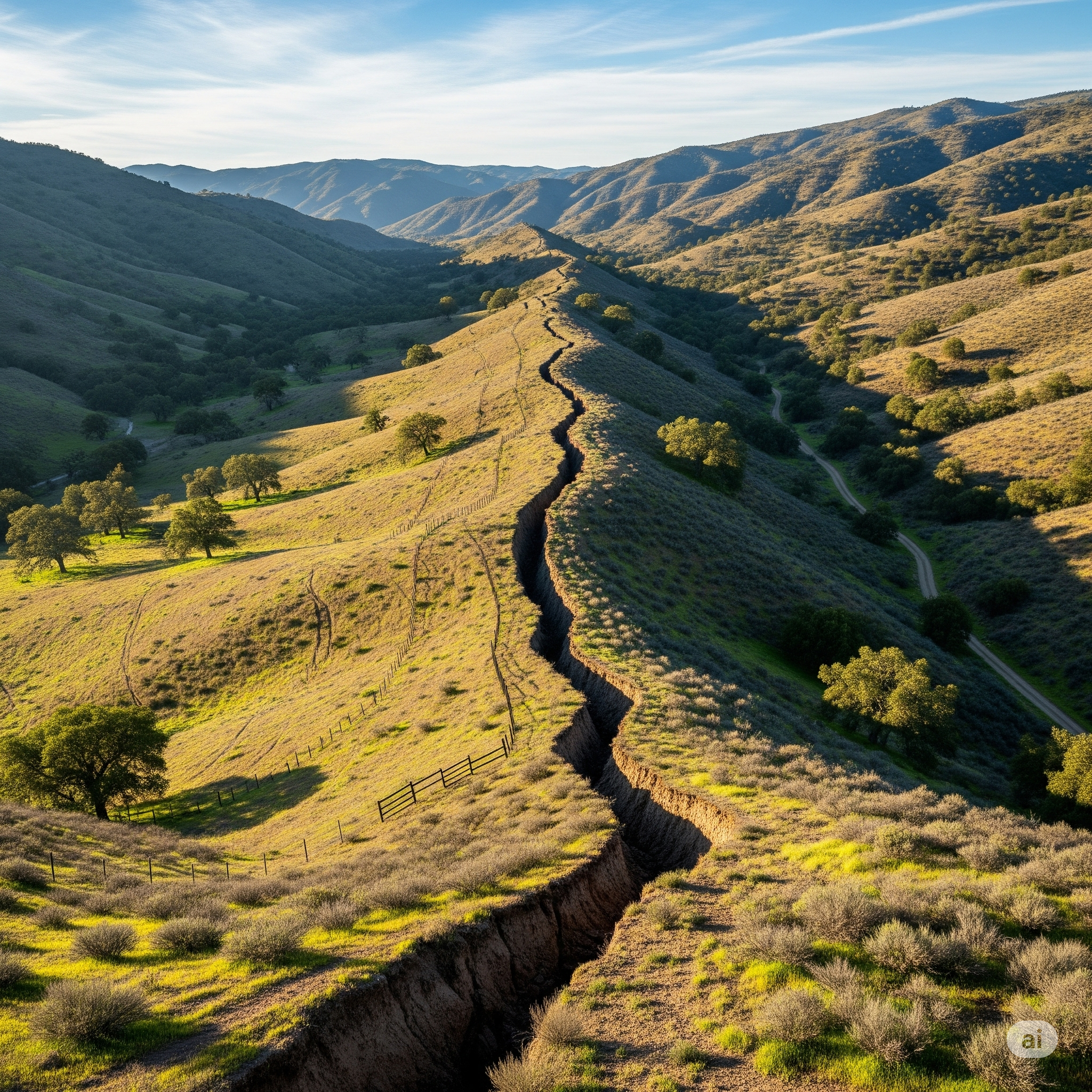
San Andreas Fault The Tectonic Threat Beneath California
The San Andreas Fault is a major crack in the Earth’s surface that runs through California. It marks the boundary between two massive tectonic plates: the Pacific Plate and the North American Plate. This fault stretches over 800 miles (about 1,300 kilometers) from Northern California near the Mendocino Coast to Southern California near the Salton Sea.
This fault is known for producing large earthquakes because the two plates constantly move against each other. While this movement is slow—only about 1 to 2 inches per year—it builds up pressure over time. When that pressure is released, it causes an earthquake.
The Importance of the San Andreas
The San Andreas Fault is one of the most well-known and scientifically significant geological features in the world. Located in California, it serves as the boundary between two massive tectonic plates: the Pacific Plate and the North American Plate. This fault runs over 800 miles through the heart of the state, from the north near Mendocino to the south near the Salton Sea.
Its importance lies not just in its size, but in its impact on both the natural world and human life. The San Andreas Fault is responsible for shaping much of California’s physical landscape, including its mountains, valleys, and coastlines. This natural formation has created the foundation for one of the most diverse ecosystems in North America.
From a scientific standpoint, the fault is a real-time laboratory for geologists and seismologists. Its constant movement—though typically slow at 1 to 2 inches per year—allows researchers to study the behavior of tectonic plates and to improve earthquake prediction technologies. These insights not only contribute to academic knowledge but also play a role in urban planning and disaster preparedness.
From a public safety perspective, the San Andreas Fault is crucial. Millions of people live near it, including in cities like Los Angeles, San Francisco, and San Jose. Understanding how this fault behaves allows communities to better prepare for earthquakes through:
-
Earthquake-resistant building codes
-
Early warning systems like ShakeAlert
-
Public awareness campaigns and emergency response training
The fault is more than a geological feature—it’s a key to understanding and surviving natural disasters in California.
Main Points San Andreas Fault:
-
The San Andreas Fault is a major crack in the Earth’s crust running through California.
-
It marks the boundary between the Pacific Plate and the North American Plate.
-
The fault stretches over 800 miles from Northern California to the Salton Sea in the south.
-
It is a transform boundary where the tectonic plates slide past one another.
-
The plates move slowly (1–2 inches per year), but this builds pressure over time.
-
When pressure is released, it causes powerful earthquakes.
-
The fault has shaped California’s mountains, valleys, and coastlines.
-
Major U.S. cities like Los Angeles, San Francisco, and San Jose lie near the fault.
-
Historical earthquakes include:
-
1906 San Francisco Earthquake – magnitude 7.9
-
1989 Loma Prieta Earthquake – magnitude 6.9
-
1857 Fort Tejon Earthquake – magnitude around 7.9
-
-
Scientists believe parts of the fault are overdue for a massive quake (the “Big One”).
-
Earthquakes along this fault can cause widespread destruction and economic losses.
-
Scientists monitor the fault using GPS, seismographs, and satellites.
-
California uses early warning systems like ShakeAlert for earthquake preparedness.
-
Understanding the fault helps in designing earthquake-resistant infrastructure.
-
Public education, drills, and emergency kits are key to surviving future earthquakes.
-
Living near the fault requires awareness and constant preparation.
-
The San Andreas Fault shows how the Earth’s surface is always changing.
Let me know if you’d like this list in a downloadable format (Word, PDF, etc.) or translated into another language.
Why Is the San Andreas Fault Important?
The San Andreas Fault is important because it influences both geology and human life in California. From a scientific perspective, it provides researchers with a live example of how tectonic plates interact. It has helped shape mountains, valleys, and coastlines in California over millions of years.
From a human perspective, the fault is critical because millions of people live near it, including in major cities like Los Angeles, San Francisco, and San Jose. A large earthquake along the fault could lead to widespread destruction, injuries, and economic losses. That’s why scientists and engineers are focused on earthquake-resistant construction, early warning systems, and emergency planning.
Potential Dangers and Earthquake Risk
One of the biggest concerns related to the San Andreas Fault is the risk of a “Big One”—a term used for a massive earthquake expected to hit Southern California someday. Studies suggest that certain sections of the fault are overdue for major movement. While we can’t predict exactly when it will happen, experts agree it is only a matter of time.
Historical earthquakes linked to the fault include:
-
1906 San Francisco Earthquake – estimated magnitude 7.9
-
1989 Loma Prieta Earthquake – magnitude 6.9
-
1857 Fort Tejon Earthquake – magnitude around 7.9
Each of these events caused widespread damage, especially in urban areas.
How Is the Fault Monitored?
Geologists use many tools to monitor the San Andreas Fault. These include GPS stations, seismographs, and satellite imaging. These technologies help detect even the smallest movements underground. Monitoring allows for better predictions and can provide early warnings that save lives.
California also has programs like ShakeAlert, an early warning system that alerts people seconds before an earthquake hits. While it’s not perfect, even a few seconds of warning can allow people to take cover, stop trains, and shut down gas lines.
Disadvantages of the San Andreas Fault
Despite its scientific value, the San Andreas Fault presents many challenges:
-
High Risk of Earthquakes: It is prone to producing strong earthquakes with little warning.
-
Threat to Life and Property: Earthquakes along the fault can cause massive destruction in populated areas.
-
Economic Impact: Damage to buildings, roads, and utilities can cost billions in repairs.
-
Infrastructure Vulnerability: Bridges, pipelines, and transport systems can be severely affected.
-
Psychological Stress: Living near the fault causes anxiety and fear of the “Big One.”
-
Insurance and Real Estate Risks: Properties near the fault may face higher insurance rates or lower value.
-
Strain on Emergency Services: After a large quake, hospitals and rescue teams may be overwhelmed.
-
Unpredictability: The exact timing of major earthquakes cannot be predicted, making planning difficult.
Comparison of San Andreas Fault vs. New Madrid Seismic Zone
| Feature / Aspect | San Andreas Fault | New Madrid Seismic Zone |
|---|---|---|
| Location | California, USA | Central USA (Missouri, Arkansas, Tennessee, etc.) |
| Plate Boundary | Transform boundary between Pacific and North American Plates | Intraplate zone within North American Plate |
| Length | Over 800 miles (1,300 km) | Around 150 miles (240 km) |
| Earthquake History | Frequent large quakes (e.g., 1906, 1989) | Major quakes in 1811–1812 |
| Population at Risk | Millions in cities like LA and SF | Lower population density but growing risk |
| Monitoring Systems | Advanced GPS, seismographs, ShakeAlert | Increasing use of monitoring tools |
| Geological Activity | Active year-round with visible surface movements | Less visible, deeper underground shifts |
| Preparedness Level | High (earthquake-resistant buildings, drills) | Moderate but improving |
| Economic Risk | Very high due to urban concentration | Moderate to high depending on quake severity |
| Media Awareness | High-profile and frequently studied | Less media attention but gaining concern |
A Fault That Demands Attention
The San Andreas Fault is both a marvel of geology and a serious concern for modern civilization. Its role in shaping California’s terrain, contributing to science, and reminding us of nature’s power cannot be overstated. While it offers valuable insight into plate tectonics, it also carries the constant threat of earthquakes that could disrupt millions of lives.
Understanding, monitoring, and preparing for what lies beneath are not optional—they are essential for the safety and sustainability of communities built near this powerful fault.
Living With a Giant Beneath Us
The San Andreas Fault is a powerful reminder that the Earth is always changing. Though it moves slowly, its impact can be sudden and devastating. Understanding how it works helps scientists, city planners, and residents prepare for the future. With better technology and increased awareness, communities in California are working toward safety while coexisting with this massive tectonic force.
If you live near the San Andreas Fault, being prepared is essential. Earthquake kits, emergency drills, and structural safety can help reduce the damage when—not if—the next big quake strikes.